

As you look for your next home, you are bound to hear the term “loan limits” pop up at least once. So, what are loan limits and why should they matter to you? Depending on where you live and the value of your home, loan limits can play a role in the type of mortgage you apply for as loan limits are based on average home prices.
WHAT ARE LOAN LIMITS?
Loan limits put a cap on how much money you can borrow for a conforming mortgage. While this limit can depend on your personal creditworthiness, there is an industry limit known as conforming loan limits (CLL) set by the Federal Housing Finance Agency (FHFA) which serves as a guideline for maximum loan sizes.
Since the FHFA regulates Fannie Mae and Freddie Mac, the conforming loan limits serve as a guideline for the maximum loan size Fannie and Freddie are qualified to purchase. As it stands, Fannie Mae and Freddie Mac are limited to purchasing single-family mortgages with origination balances below the CLL.
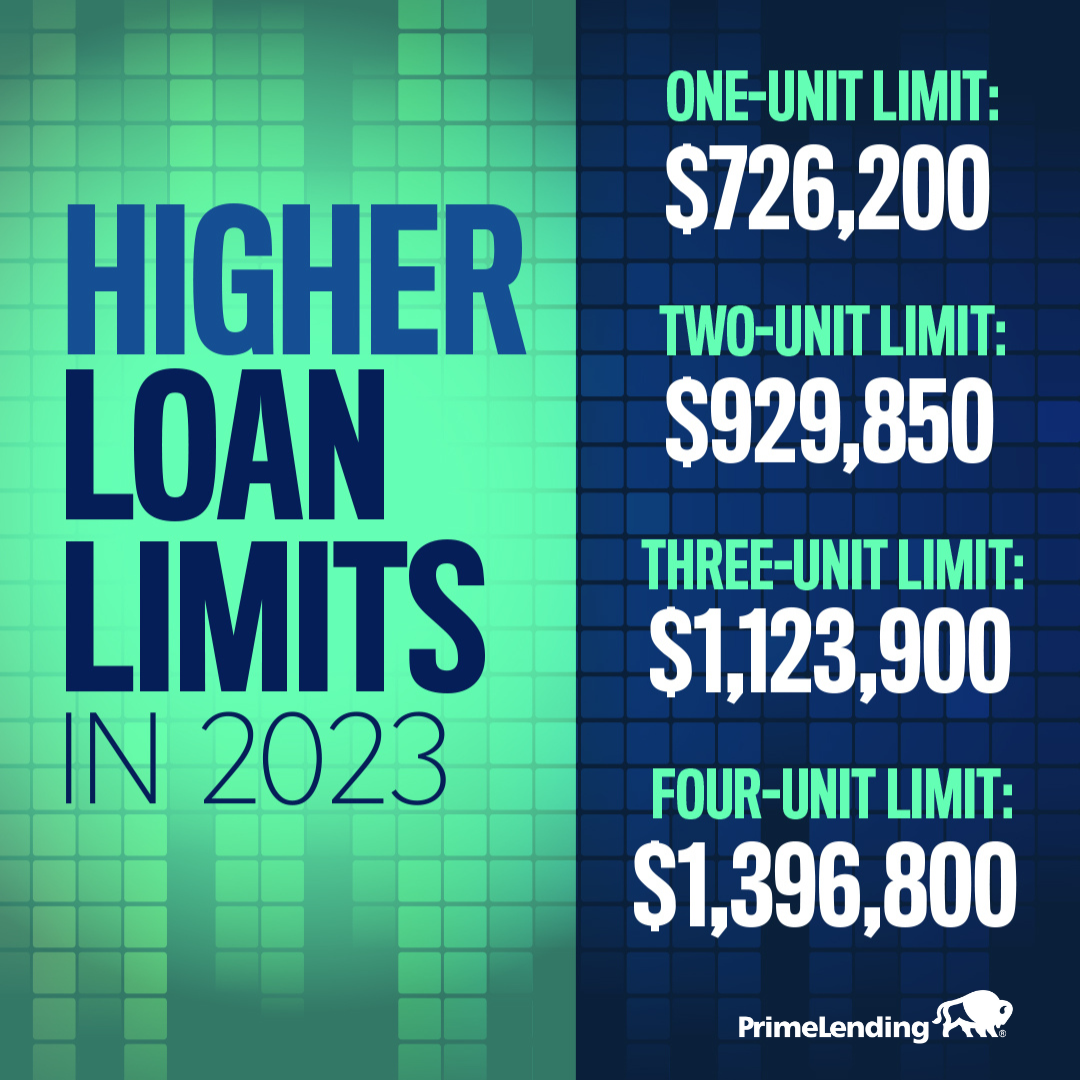
Loan limits can change year-over-year. For example, the CLL for 1-unit residences in 2022 was $647,200 and is increasing to $726,200 in January 2023. However, where you live makes a difference in the CLL for your area. In higher-cost areas, like Alaska and Hawaii, the loan limit on a 1-unit property will increase to $1,089,300. To better understand loan limits in your area, you can always reach out to a mortgage professional.
WHY DO LOAN LIMITS MATTER?
Loan limits are what separate conforming loans from jumbo loans. Knowing loan limits in your area matters because if the home you want to purchase costs more than the conforming loan limits, you may need to consider a jumbo loan. Plus, you will go into your home search as a more informed homebuyer which can help make your mortgage process easier.
Conforming loans, not to be confused with conventional loans, are mortgages that meet the guidelines set by Fannie Mae and Freddie Mac and the CLL set by the FHFA. Any mortgage that exceeds the conforming limits is considered a jumbo or “non-conforming” loan.
A jumbo loan is a viable option when the home you have your heart set on calls for a larger loan amount.
CONFORMING vs. NON-CONFORMING LOAN BENEFITS
Sometimes it can be easier to understand something when you know how to categorize it. Just as foods fall under sweet or savory, every loan falls under either conforming or non-conforming.
The benefits of a conforming loan from PrimeLending include:
- More simple to apply and qualify for (less paperwork, fewer rules and regulations)
- Wider range of loan options (more flexible terms, easier to customize to your needs)
- Can be used on more property types (single-/multi-family homes, condos, manufactured homes)
- No required mortgage insurance (if you put at least 20% down)
On the other hand, benefits of a PrimeLending non-conforming loan are:
- Loans up to 80% of the home’s value (that require 20% down)
- Available as either fixed- or adjustable-rate mortgages
- Allow down payment in the form of a gift (on some programs)
- Some programs offer up to $3 million in financing
Buying a home is unique to everyone, which is why PrimeLending will always take your budget and home needs into account to help you find your best home loan option. Talk to your local loan expert today to discuss if a conforming or non-conforming loan could work for you.