


Finding a home in your price range is one thing. Getting the monthly payment where you need it is another. When the payment comes in higher than expected, waiting for mortgage rates to fall isn’t your only option.
A seller or builder paid temporary buydown may reduce the amount you pay during the first few years of your mortgage, while discount points may lower your rate for as long as you keep the current loan. Meanwhile, seller concessions could help cover either option or other eligible costs, depending on your loan program and purchase agreement.
The right choice comes down to what would help you most: a lower payment at first, potential savings over time or less cash due at closing.
What is a Temporary Mortgage Buydown?
It’s happened to homebuyers before. They find the perfect home that’s priced in their budget, but one look at the full payment (principal, interest, property taxes and homeowners insurance) and they start to second-guess if they can really afford to buy a home. If that feeling sounds familiar, you aren’t alone.
If you’re looking for a way to lower your initial payments and ease into homeownership, a builder or seller paid temporary buydown could be a viable option.
Money set aside at closing covers part of your payment for a limited time, so you pay less at first and gradually move into the full payment. Your permanent mortgage rate doesn’t change. That extra room could be helpful when you’re also paying for moving expenses, furniture, repairs and the other costs that often come with a new home.
You’ll typically need to qualify based on the full payment, so it’s important to make sure that amount fits your budget from the beginning.
Different Types of Temporary Buydowns
The types of temporary buydowns available to you will depend on how long you want to reduce your effective interest rate. Most temporary buydowns lower the interest rate for at least a year, and can reduce the rate for up to 3 years. Once the buydown period is over, the loan will return to the full note-rate payment.
A 3-2-1 temporary buydown reduces the interest rate by 3% the first year, 2% the second year and 1% the third year. Then there’s the 2-1 temporary buydown which reduces the interest rate by 2% the first year and 1% the second year. With a 1-1 temporary buydown, the interest rate is reduced by 1% for the first two years of the loan. Finally, the 1-0 temporary buydown can reduce a buyer’s interest by 1% for the first year of the loan.
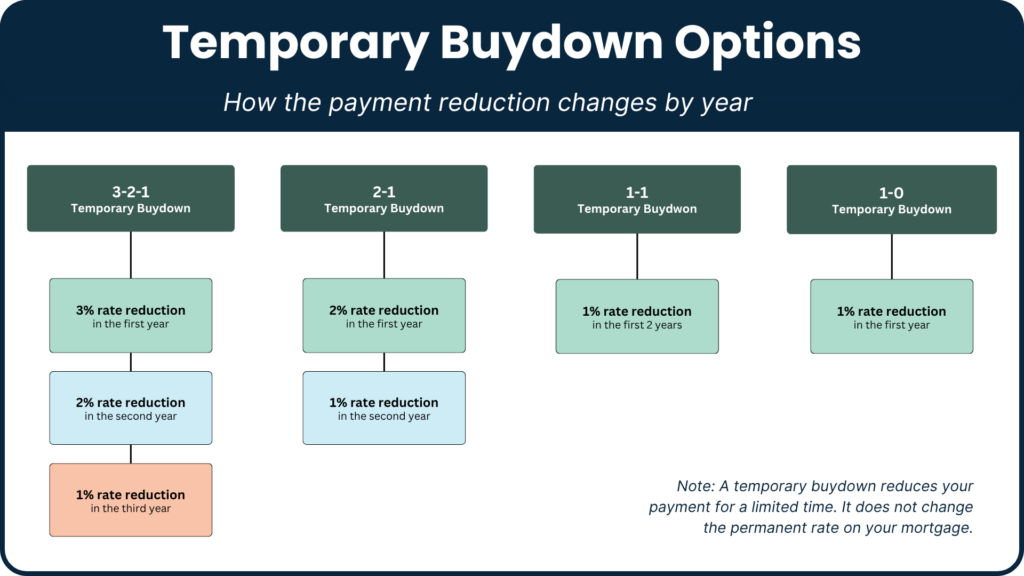
No matter which buydown you use, the payment will eventually rise to the full amount after the buydown period ends. So be sure to plan for that while you are saving in the first few years of your loan.
What are Mortgage Discount Points?
If you’re more concerned about how much your loan will cost over time, discount points may be the better fit.
With discount points, you can permanently lower your interest rate by paying more at closing. Typically, one discount point costs 1% of the loan amount. For example, on a $360,000 loan one point would cost $3,600.
The amount a point lowers your rate can vary based on the product and loan characteristics . Paying points may reduce your monthly principal-and-interest payment and the amount of interest you pay over time, but only if you keep the mortgage long enough to recover the upfront cost.
When Do Discount Points Start Saving You Money?
Typically, discount points can start saving you money once you hit your “break-even point.” This is the point at which you’ve saved enough to recoup what you originally paid for the mortgage discount point(s). Here’s a quick example to show how to calculate your break-even point.
Say you purchased one discount point on your $360,000 loan. That cost you $3,600 but lowered your principal-and-interest payment by $90 a month. To find your break-even point, you divide the cost of the discount point by your monthly savings:
$3,600 ÷ $90 = 40 months
Using this example, it would take roughly 40 months for your savings to equal your upfront costs.
If you plan to keep the mortgage after you break even, the points will start to provide savings over time. But, if you think you will be moving or refinancing before then, you may want to consider another option.
What’s the Difference Between a Temporary Buydown and Discount Points?
Both a temporary buydown and discount points can help lower your payment, but they each provide a different benefit.
A temporary buydown gives you more flexibility during the first few years of your loan. Discount points (or mortgage points) are designed to provide savings for the long term.
What to Compare | Temporary Buydown | Discount Points |
What it helps with | Lower payments at the beginning | A lower rate for the current loan |
How long the benefit lasts | Usually one to three years | As long as you keep the mortgage |
What you pay upfront | Funded through an eligible seller or builder contribution | Usually paid at closing by the buyer or another eligible party |
What happens later | Your payment increases to the full amount | Your payment stays based on the lower rate |
Could make sense when | You want more room in your budget after moving | You expect to keep the loan long enough to recover the cost |
Seeing both options side by side can make it easier to see which choice better suits you. If you need help comparing the two, contact your local PrimeLending loan officer to run a customized scenario with your actual numbers.
How Can Seller Concessions Be Used?
A lower rate might be the first thing that comes to mind, but it may not be where you need the most help.
Seller concessions are the contributions or credits a home seller agrees to pay at closing on the homebuyer’s behalf. Depending on your loan and purchase agreement, seller concessions may be used toward eligible expenses such as:
- A temporary buydown
- Discount points
- Closing costs
- Prepaid property taxes
- Homeowners insurance
Deciding the best use for your seller concessions comes down to your budget. Before committing to one option over the other, ask yourself these three questions:
- Would a lower payment during my first few years help most?
- Would I benefit more from bringing less cash to closing?
- Will I need money available after the move?
Seller concessions are negotiated as part of the overall purchase agreement, so compare both the home’s price and the value of the credit when reviewing your options.
Frequently Asked Questions
Does a temporary buydown change my mortgage rate?
No. Your permanent note rate stays the same. Funds set aside at closing temporarily cover part of your payment during the buydown period.
What happens when a temporary buydown ends?
You begin making the full payment based on the note rate. Make sure that later payment fits your budget before choosing the loan.
How much will one discount point lower my rate?
One (1) discount point costs 1% of the loan amount. Each discount point may lower the interest rate as much as 0.25%, depending on product and loan characteristics.
Are discount points always a good investment?
Not necessarily. Their value depends on the upfront cost, monthly savings and how long you keep the mortgage.
Can a seller pay for a temporary buydown or discount points?
They may be able to, depending on your loan program, purchase agreement and applicable contribution limits.
See What Each Option Could Mean for Your Payment
A higher rate environment doesn’t automatically mean you have to put your homebuying plans on hold. Your actual options depend on the home, loan and details of your purchase. And the right strategy could mean a lower payment while you settle in, a lower rate for the life of the loan, or a mortgage that better matches your timeline.
Instead of assuming what your rate is based on headlines, contact us to get a customized estimate.